What Happened: The Shooting, Minute by Minute
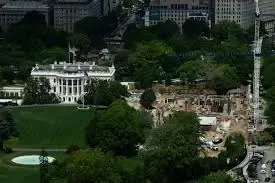
At approximately 6:10 PM Eastern Time on Saturday, May 23, 2026, a man was seen pacing back and forth along 17th Street Northwest near Pennsylvania Avenue.
This stretch of pavement is just outside the Eisenhower Executive Office Building, adjacent to the White House complex.
Witnesses observed erratic behaviour before the man approached a US Secret Service security checkpoint, reached into his bag, and removed a revolver.
He fired. Secret Service agents at the checkpoint returned fire immediately.
Between 15 and 30 shots were exchanged in total, according to law enforcement sources cited by CBS News.
Multiple CBS News reporters on the White House North Lawn heard what sounded like rapid gunfire at around 6 PM before Secret Service ushered them inside. A lockdown of the White House was placed immediately.
The suspect — identified by multiple sources as Nasire Best, 21, of Maryland — was struck by Secret Service gunfire.
Paramedics transported him to George Washington University Hospital, where he was pronounced dead.
A civilian bystander was also shot during the exchange and was taken to hospital in critical condition.
One US Secret Service agent was evaluated at the scene as a precaution but was not hospitalised. None of the Secret Service officers were believed to have been struck by the suspect's gunfire.
The White House lockdown was lifted just before 7 PM.
President Donald Trump was inside the White House during the entire incident and was not impacted.
The press was allowed back on to the North Lawn after the scene was cleared.
Who Is Nasire Best? The Suspect's Background
Nasire Best was a 21-year-old man from Maryland.
Multiple law enforcement sources identified him to Fox News Digital, CBS News, and other outlets as the individual who opened fire at the checkpoint.
He was not a complete unknown to federal authorities. His history with the Secret Service stretches back at least a year before Saturday's shooting.
Prior Secret Service Encounters
Best was detained on June 26, 2025 for flagging down Secret Service agents and making threats. He was detained again on July 10, 2025 for attempting to enter a restricted area near the White House — after which he was sent to a psychiatric ward for mental health evaluation. Saturday's shooting was his third documented encounter with the Secret Service in under a year.
Sources told Channel 2 Now and other outlets that Best had a documented history of severe mental health issues.
Multiple law enforcement sources said he reportedly believed he was Jesus Christ — a delusion that had previously brought him into contact with federal authorities.
Conservative attorney Mike Davis, citing law enforcement, confirmed on X that Best "had serious mental-health issues" and was known to federal agents before the shooting.
New York Post sources said Best used a revolver and managed to fire only a few shots before he was "quickly shot and killed in a hail of bullets from federal officers."
Investigators recovered the pistol believed to belong to him at the scene.
Official Responses: Trump, Secret Service, Congress
The US Secret Service issued a formal statement confirming the sequence of events.
According to the agency's preliminary investigation, the individual "approached a checkpoint shortly after 6 p.m. ET, removed a weapon from his bag and began firing at posted officers."
Officers returned fire and struck the suspect, who was transported to an area hospital where he later died.
President Trump was notified immediately. The White House confirmed he "was not impacted."
No statement from the President himself was immediately released.
However, the administration confirmed that Principal Deputy Director of National Intelligence Aaron Lukas — who also assumed acting DNI duties hours earlier following Tulsi Gabbard's resignation — was monitoring the situation.
House Speaker Mike Johnson praised the federal response directly on X.
"We are grateful for our brave Secret Service agents who took quick, decisive action to protect President Trump, and our prayers are with the victims of tonight's senseless shooting for a speedy recovery," he said.
"Our law enforcement officers run into harm's way each day to keep us safe, and they deserve our unwavering support."
Senator Markwayne Mullin also praised the Secret Service for its "bravery and swift response."
FBI Director Kash Patel confirmed that operatives are assisting the Secret Service in the ongoing investigation.
The Bureau of Alcohol, Tobacco, Firearms and Explosives (ATF) confirmed they are also investigating.
The Second Incident in 29 Days — A Pattern Around the White House
Saturday's shooting did not occur in isolation.
It came exactly 29 days after another armed incident connected to the White House Correspondents' Dinner at the Washington Hilton on April 25, 2026.
In that incident, Cole Tomas Allen, armed with a 12-gauge shotgun and a semi-automatic pistol, sprinted through a security checkpoint as reporters and Trump administration officials ducked for cover.
Allen was charged with attempting to assassinate the President of the United States and has pleaded not guilty.
CNN noted that Saturday's incident "comes less than a month after the White House Correspondents' Dinner, where reporters and Trump administration officials ducked for cover as shots rang out."
This has heightened concerns about security in areas surrounding the White House complex.
Two serious armed incidents in 29 days at sites associated with the President of the United States is historically unusual and will likely prompt a formal security review.
April 25, 2026 — WHCD Shooting
Cole Tomas Allen armed with shotgun and pistol targeted the White House Correspondents' Dinner. One officer hit in bulletproof vest. Allen charged with attempting to assassinate Trump administration officials. Pleaded not guilty.
May 23, 2026 — Pennsylvania Ave Shooting
Nasire Best, 21, opened fire at Secret Service checkpoint. Shot dead by agents. Bystander in critical condition. FBI, ATF, and Metropolitan Police investigating. No confirmed motive yet.
Key Questions Answered
Who is Nasire Best, the White House shooter?
Nasire Best was a 21-year-old man from Maryland who opened fire at a US Secret Service checkpoint near the White House on May 23, 2026. He was shot and killed by Secret Service agents. Sources say he had a documented history of severe mental health issues and believed he was Jesus Christ. He had been detained by the Secret Service twice in 2025 — in June for making threats and in July for attempting to enter a restricted area, after which he was hospitalised in a psychiatric ward.
Was Trump in the White House during the shooting?
Yes. President Donald Trump was inside the White House during the shooting. The Secret Service confirmed he was not impacted or harmed. The gunman did not breach the White House perimeter.
Was anyone killed or injured in the White House shooting?
Yes. The shooter, Nasire Best, was shot by Secret Service agents and later died at George Washington University Hospital. A civilian bystander was also shot and is in critical condition. One Secret Service agent was evaluated at the scene as a precaution but was not hospitalised.
What was the motive behind the White House shooting?
No official motive has been confirmed. Law enforcement sources told multiple outlets that Best suffered from significant mental health issues and reportedly believed he was Jesus Christ. The FBI, ATF, and Metropolitan Police are investigating. No links to terrorism, foreign actors, or political motivation have been stated.
How many shots were fired at the White House?
Between 15 and 30 shots were fired in total, according to law enforcement sources cited by CBS News. The suspect fired first using a revolver. Secret Service agents returned fire with what sources described as a rapid barrage of gunfire.
Context: Mental Health, Warning Signs, and the System That Missed Them
The most urgent question emerging from Saturday's shooting is not about intent — it is about systems.
Nasire Best was not unknown to the Secret Service. He was detained twice in 2025 and sent to a psychiatric ward. His name was in federal databases.
And yet, on May 23, 2026, he was able to walk to within arm's reach of a Secret Service checkpoint carrying a loaded revolver.
This pattern is not new in the history of White House security incidents.
In 2016, Jesse Olivieri — also 31, also with a history of mental illness including paranoid delusions — drove to the White House and fired at a security checkpoint. He survived.
In 2011, Oscar Ramiro Ortega-Hernandez fired an assault rifle at the White House from his car, driven by an obsession with President Obama. He was 21.
In every case, the individual had documented contact with mental health systems before the incident.
Saturday's shooting will almost certainly prompt a review of how the Secret Service tracks individuals with prior encounters — particularly those who have been sent for psychiatric evaluation.
It will also raise questions about what legal tools exist to prevent them from legally acquiring firearms after such evaluations.
Those questions will take time to answer. For now, the investigation continues.
Intelligence Assessment
Saturday's shooting at the White House checkpoint is the second serious armed incident near the President of the United States in 29 days.
Neither was linked to foreign actors or organised terrorism. Both appear to involve individuals with mental health histories who had prior contact with law enforcement.
The immediate security response — from initial shots to suspect neutralised — was under two minutes, reflecting Secret Service's checkpoint protocols functioning as designed.
The systemic question is how a man twice detained by Secret Service and hospitalised for psychiatric evaluation retained the ability to legally obtain a firearm and return to the same location.
This will be the focus of congressional and administrative attention in the days ahead. That question does not have a quick answer.
The investigation by the FBI, ATF, and Metropolitan Police is ongoing. This article will be updated as verified information becomes available.